


Toward a New Era in Electron Microscopy and Medical Imaging
Prof. Ido Kaminer and Prof. Yehonadav Bekenstein of the Technion have been awarded ERC Proof of Concept (PoC) grants by the European Research Council. The grants are expected to lead to a major leap forward in low-radiation medical imaging and in the precise mapping of biological tissues.
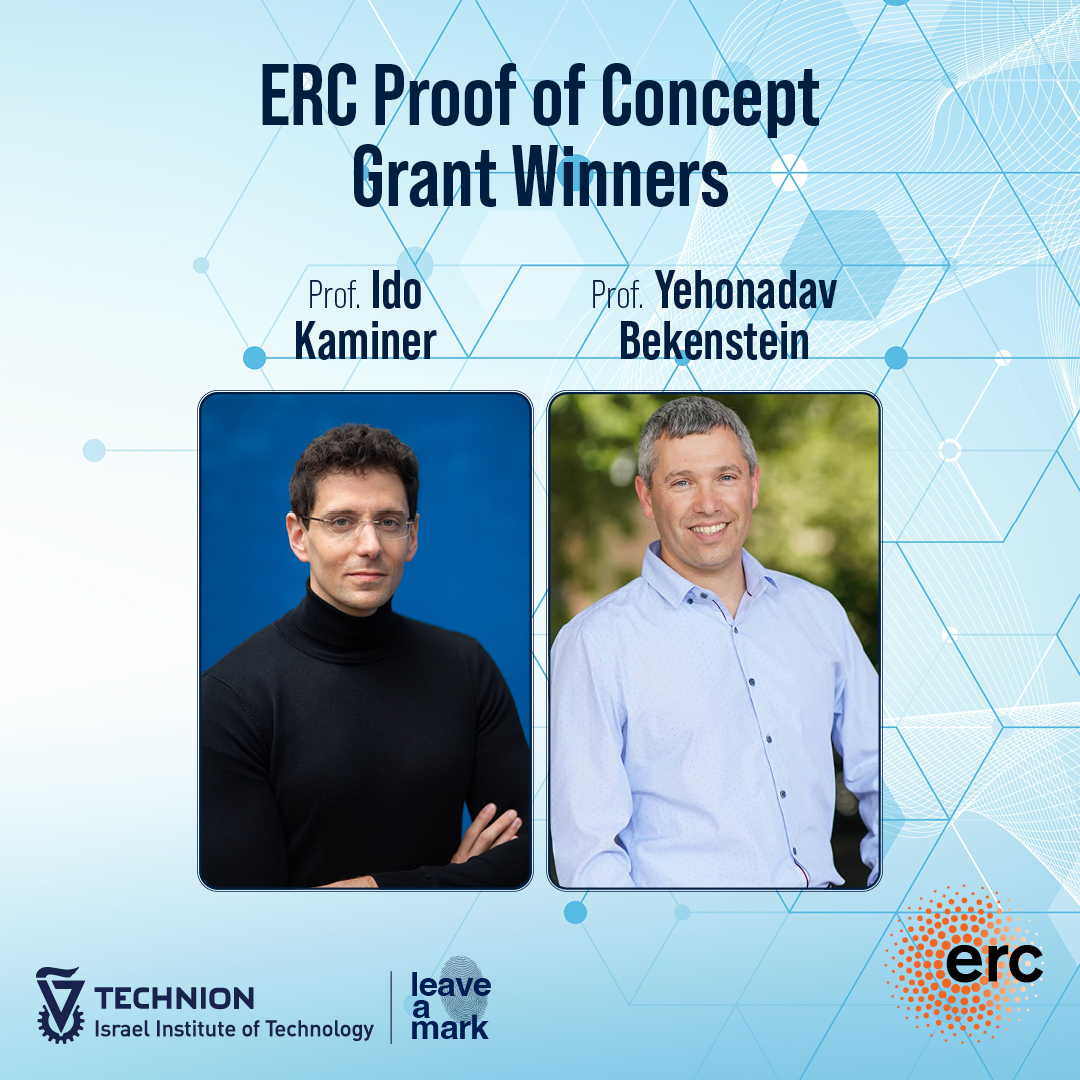
Two young researchers from the Technion have won the prestigious ERC PoC grants from the European Research Council (ERC). Proof of Concept grants are feasibility grants designed to promote the transition from academic research to application and commercialization, including the establishment of a startup company, and are awarded only to researchers who have previously received ERC grants. Grant amount: €150,000 each.
The two recipients are Prof. Ido Kaminer from the Andrew and Erna Viterbi Faculty of Electrical and Computer Engineering and Prof. Yehonadav Bekenstein from the Faculty of Materials Science and Engineering. Both joined the Technion faculty in the same year, 2018, and in 2025 inaugurated a joint interfaculty laboratory: the Quantum Microscopy Lab. This innovative lab is equipped with state-of-the-art microscopes capable of detecting quantum phenomena that cannot be studied by other means. The laboratory, which also includes Dr. Michael Krüger from the Faculty of Physics, was established following the Technion’s success in a call issued by the National Authority for Technological Innovation, with support from the Helen Diller Quantum Center at the Technion.
Prof. Yehonadav Bekenstein, a graduate of the Hebrew University of Jerusalem, joined the Technion faculty after a Rothschild postdoctoral fellowship at the University of California, Berkeley. He is considered a leading scientist in materials discovery, specializing in light-emitting nanomaterials and perovskites the technology at the heart of the new sensor that earned him the grant. His scientific work has been recognized with a series of prestigious awards, including the Krill Prize for Excellence in Scientific Research and the Goldberg Prize from the Technion.
The grant Prof. Bekenstein received will be used to advance MagicLayer a sensor for a new generation of medical imaging with minimal radiation exposure. The scientifc idea of the developed technology is based on nanocrystals and ultrafast quantum light emission.
Sensors used in medical imaging are currently limited by their response speed. This relative slowness leads to the loss of valuable information and forces physicians to increase patients’ exposure to radiation. Standard crystals used in industry have reached the limits of their classical physical capabilities and struggle to deliver the field’s “holy grail,” which is a time resolution of 10 picoseconds. This is where the new sensor comes in; it is based on arrays of nanocrystals developed at the Technion. The light emitted from these arrays is correlated and responds significantly faster than existing technologies. The technology is relevant not only to medicine but also to improving electron microscopes and to real-time monitoring of radioactive gases in nuclear facilities. The research team behind the winning proposal includes Dr. Georgy Dosovitskiy, Dr. Rotem Strassberg, and Shai Levy.
Prof. Ido Kaminer, who completed all of his degrees at the Erna and Andrew Viterbi Faculty of Electrical Engineering, returned as a faculty member after a postdoctoral fellowship at MIT. He is a world-renowned scientist in photonics, electron microscopy, light–matter interactions, quantum information processing, and mathematical discoveries using artificial intelligence. His scientific work has earned him numerous honors, including the Stanisław Lem Prize, the Schmidt Science Polymath Award, the Blavatnik Award, the Krill Prize, and election to the Israeli Young Academy.
His new grant will be used to develop Stork – an innovative module that improves the performance of transmission electron microscopes (TEM). These instruments are widely adopted for biological applications as well as semiconductor metrology and inspection. However, their capabilities across both fields are highly limited owing to low contrast, which hinders resolution and throughput. The Stork technology makes it possible to introduce light directly onto the studied specimen, while also efficiently collecting the light emitted from it, thereby enhancing the TEM imaging capabilities dramatically. This paradigm shift in TEM technology will provide unprecedented information for imaging biological tissues and atomic-scale defects in electronic devices. The research team behind the winning proposal includes Dr. Tal Fishman, Dr. Michael Yannai, and Dr. Raphael Dahan, as well as students Marta Rozhenko and Rotem Elimelech.
Photo credit: Nitzan Zohar, Technion Spokesperson’s Office.


